Keep it simple.
A flag should be recognizable at a glance and easy to reproduce.
 THE EMPIRE STAR
AN INDEPENDENT PROPOSAL FOR NEW YORK STATE
The waterways that connected a nation. The commerce that built an empire. The state at the center of it all.
Discover the Empire StarSupport the project →THE EMPIRE STAR · PROPOSED STATE FLAG01 / THE CASE FOR CHANGE
New York is one of the most recognizable places in the world. Its history, institutions, industries, and people have helped shape the United States and influence the world beyond it. Yet its state flag is difficult to distinguish from those of many other American states.
A great flag is more than an official government emblem. It is a shared expression of identity—a symbol that people recognize, embrace, and proudly make their own.
In Colorado, Chicago, and Washington, D.C., flags have become part of everyday life. They appear on clothing, buildings, businesses, public spaces, and personal belongings. Their designs are so recognizable that they communicate a sense of place without a single word.
New York deserves a symbol with that same power.
The Empire Star proposes a new visual identity for the Empire State: one rooted in its extraordinary history, reflective of its enduring character, and designed to become a lasting source of pride for all New Yorkers.
The most successful flags share a common quality: they communicate identity through simplicity.
A flag must work under conditions that other forms of graphic design do not. It must be recognizable from a distance, while moving in the wind, when reproduced at a small scale, and when viewed from either side. Its design must be memorable enough to recognize immediately and simple enough to reproduce from memory.
The principles of good flag design are straightforward:
A flag should be recognizable at a glance and easy to reproduce.
Every element should communicate something important about the place and people it represents.
A restrained palette creates stronger contrast and a more memorable identity.
Fine details and written words become difficult to distinguish at a distance.
A flag should possess an identity of its own, rather than be easily confused with those of other places.
These principles are not merely aesthetic preferences. They help determine whether a flag can become an enduring and widely recognized civic symbol.
Adapted from the North American Vexillological Association’s Good Flag, Bad Flag.
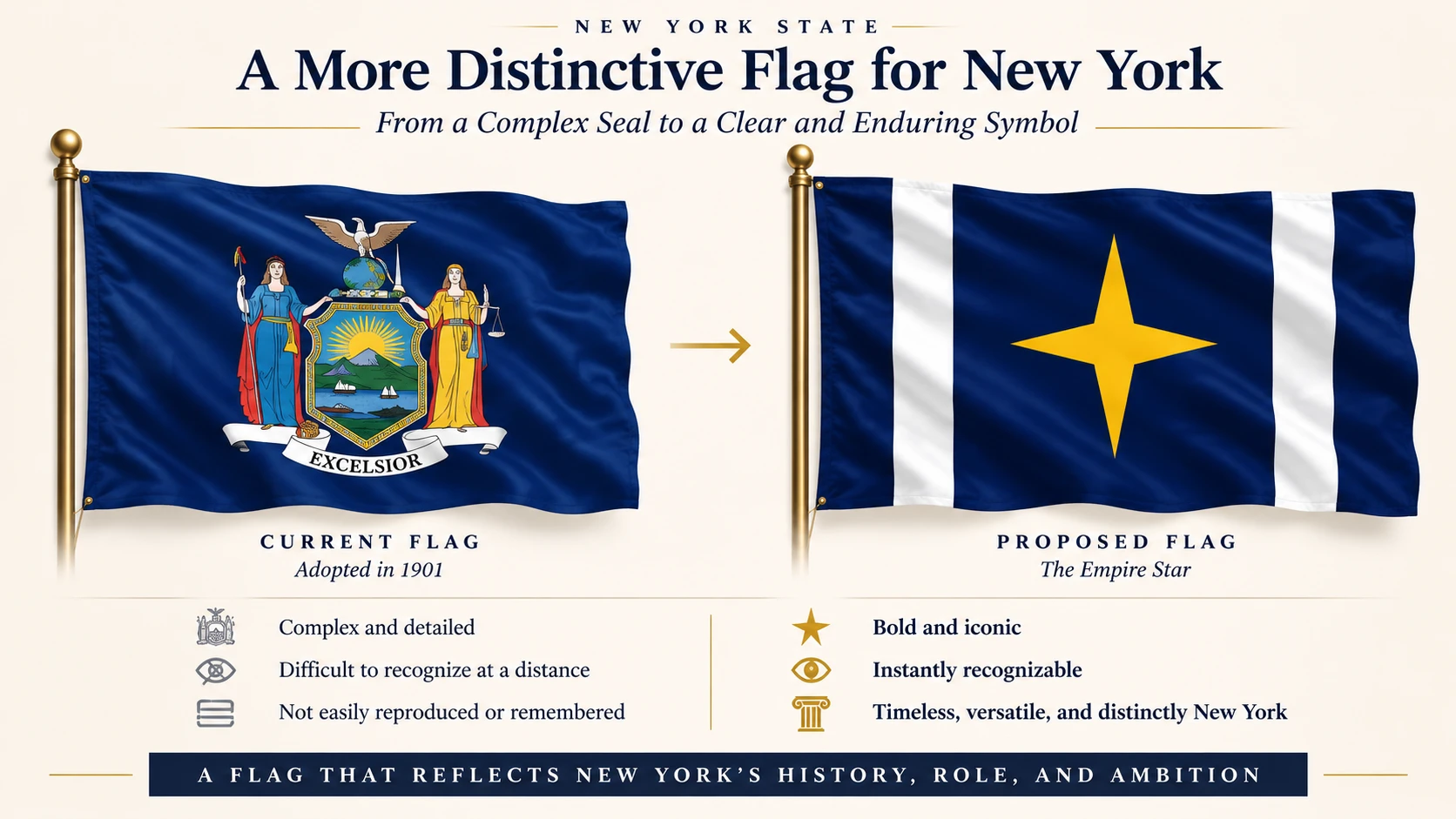
| Principle | Current flag | Empire Star |
|---|---|---|
| Simplicity | Detailed figures, shield and landscape | Two bands and one bold star |
| Meaningful symbolism | Rich heraldry that requires close inspection | Waterways, commerce and four enduring values |
| Limited colors | Numerous colors within the arms | Three contrasting colors |
| No lettering or seals | Coat of arms and written mottos | No text or intricate heraldry |
| Distinctiveness | Shares the blue-field arms format of many states | A recognizable arrangement of vertical bands and gold star |
New York's coat of arms is a valuable part of the state's historical and institutional heritage. Its imagery and mottos deserve to be preserved.
But a coat of arms and a flag serve different purposes.
A coat of arms communicates through intricate heraldic imagery. A flag communicates through immediate visual recognition. What works on an official document or government seal does not necessarily work on a flagpole.
The Empire Star is not a rejection of New York's history. It is an effort to express that history through a visual language better suited to a flag.
New York can preserve its historic coat of arms while adopting a flag that is simpler, more distinctive, and more accessible to its people.
Colorado, Chicago and Washington, D.C. demonstrate how a recognizable flag can become part of the cultural fabric of a place.

A bold central emblem.

Waterways and distinctive stars.

Memorable stripes and stars.
02 / THE DESIGN
The Empire Star features a deep navy blue field divided by two parallel vertical white bands, creating five alternating columns of navy blue and white. A prominent four-pointed gold compass star sits at the center of the wider central navy blue column.
The symmetrical composition emphasizes the central compass while maintaining a clean, balanced relationship between the surrounding bands.
The flag employs three colors—navy blue, white, and gold—and a simple geometric design intended to remain distinctive, easily reproduced, and recognizable at a distance.
The navy blue field represents the Great Lakes and Atlantic Ocean, the great bodies of water that connected New York to the continent and the world.
The two vertical white bands symbolize the Erie Canal and Hudson River, whose complementary roles created one of the most consequential commercial corridors in American history. Their parallel arrangement is symbolic rather than geographic, honoring the two waterways as the foundations of New York’s economic rise.
The four-pointed gold compass represents New York’s position at the center of American commerce. Its four cardinal points evoke navigation, exploration, and the movement of goods, people, capital, and ideas across the continent and around the world. Its gold color symbolizes the wealth, opportunity, and economic growth generated by trade, industry, and enterprise.
The central placement of the compass, framed by the two white bands, reflects the relationship between New York's waterways and its economic ascendancy. The waterways provide the foundation of the flag's composition, while the gold compass represents the commercial empire they helped create.
Together, these elements celebrate New York not merely as a conduit for American commerce, but as a driving force behind the nation's economic expansion and emergence as a global power.
Each point of the gold compass carries two complementary meanings: a historic geographic connection and an enduring quality that helped shape New York. These are proposed meanings of the new emblem, not traditional meanings of the state’s existing arms.
Inspired by Excelsior, “ever upward”: the pursuit of excellence. Historically, Canada and the northern trading frontier.
Commerce, agriculture, industry and investment that helped build a nation. Historically, the Erie Canal, Great Lakes and American interior.

Creativity, discovery and progress, from science and technology to the arts. Historically, Europe and international markets.
The promise of a better future, inspired by New York Harbor and generations of immigrants. Historically, the Hudson and Atlantic commerce.
The points represent New York’s reach and character; their common center represents the state itself and its shared prosperity.
At the heart of the flag stands the Empire Star, a four-pointed gold compass representing New York's historic position at the crossroads of American commerce and its enduring connection to the world.
Each cardinal point carries two complementary meanings: a geographic connection that helped shape New York's history and an enduring principle that defines its character.
Inspired by New York's historic motto, Excelsior, the northern point represents the pursuit of excellence and the determination to reach ever upward. It also honors New York’s historic commercial connections with Canada, Lake Champlain, and the St. Lawrence River.
Inspired by New York Harbor and its history as a gateway to America, the southern point represents the promise of opportunity and the ability of individuals to build a better future. It honors generations of immigrants, workers, entrepreneurs, and families, and the Hudson River’s passage to the Atlantic.
Looking toward the rising sun and the wider world, the eastern point represents creativity, ingenuity, discovery, and the continual pursuit of progress. It evokes Europe and international markets, and New York’s contributions to science, technology, medicine, education, culture, architecture, and the arts.
Inspired by the Erie Canal and New York's historic connection to the American interior, the western point represents the entrepreneurial spirit, commerce, industry, and investment that helped build the American economy. It honors the Great Lakes, agriculture, infrastructure, and the industrial development of upstate New York.
The four points meet at a common center, representing New York itself. Their unity reflects the collective strength of a state whose people, communities, and institutions have helped shape the nation.
The star's gold color symbolizes the prosperity generated by these qualities—not merely material wealth, but the broader economic, cultural, and human achievements of New York.
Together, the four pillars honor New York's past, express its present character, and articulate its aspirations for the future.
The Empire Star represents New York as the point where geography became opportunity, commerce became prosperity, and a growing nation found its gateway to the world.
03 / OUR HISTORY

The Empire Star honors New York's historic role as the commercial crossroads of the United States and the gateway through which the American interior became connected to the wider world.
The completion of the Erie Canal in 1825 fundamentally altered the economic geography of the young nation. By connecting the Great Lakes to the Hudson River, the canal established a vital commercial route between the American interior and the Atlantic Ocean. New York Harbor became the principal maritime outlet for much of this commerce, helping establish New York as the nation's leading center of trade, finance, and enterprise.
The flag celebrates both this geographic advantage and the ambition, ingenuity, and investment that transformed it into a foundation of American economic power.
New York’s natural harbor, financial institutions, immigration and industrial development also contributed to its rise.
Further reading: New York State Canal Corporation · New York State Museum
04 / BEYOND THE FLAG
The greatest measure of a flag's success is not how often it flies above a government building. It is how readily people embrace it as their own.
Imagine a symbol of New York that appears in shop windows, on baseball caps, outside homes, on university campuses, at sporting events, and on aircraft traveling around the world.
A symbol that belongs equally to Buffalo and Brooklyn, Rochester and Manhattan, Albany and the Adirondacks.
A symbol that needs no lettering to announce where it comes from.
That is the ambition of the Empire Star: not simply to replace an existing flag, but to create an enduring expression of New York identity.

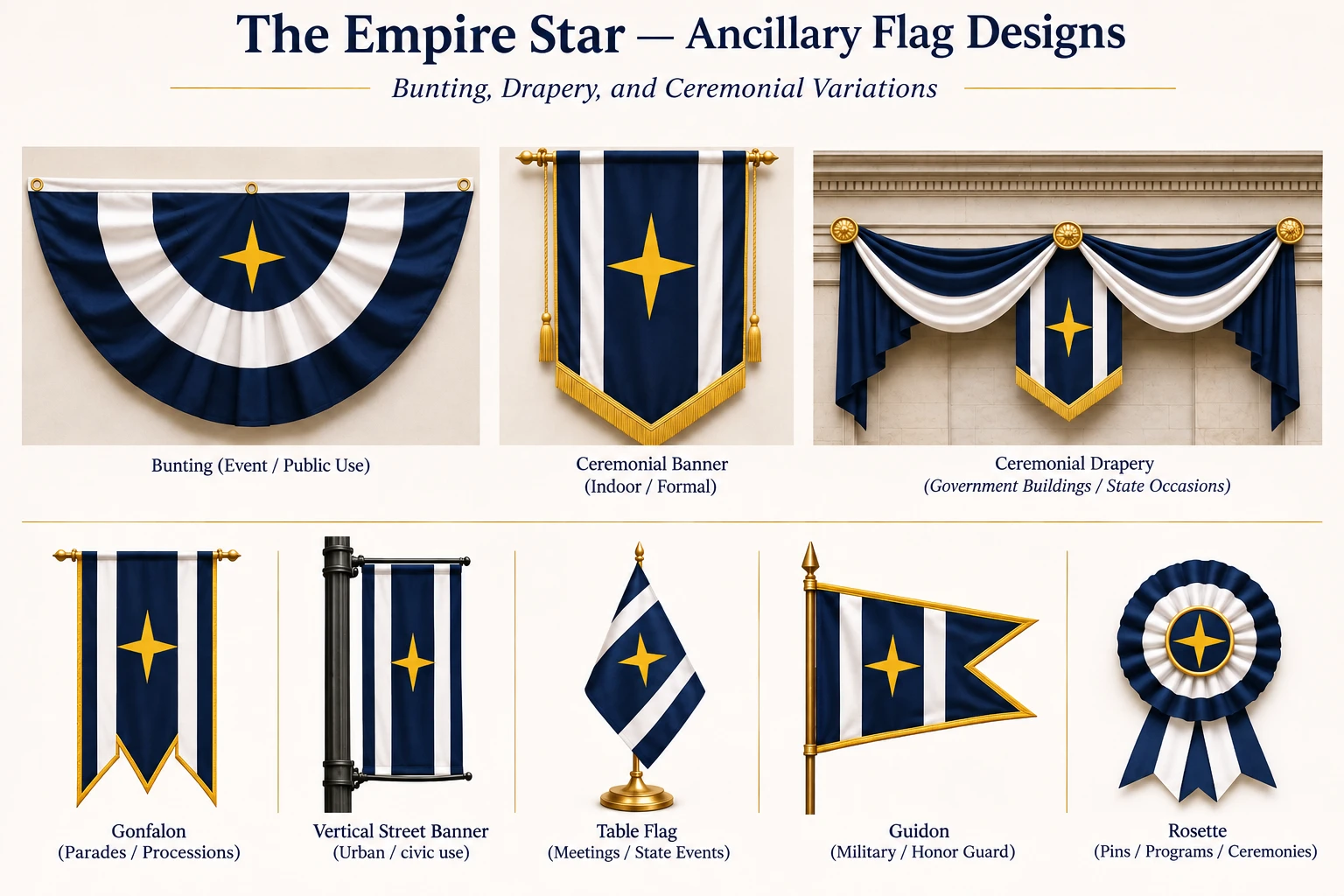
05 / COMMON QUESTIONS
No. The proposal preserves the historic coat of arms and expresses the state’s history through simpler flag symbolism.
The waterways honor the infrastructure and geography that helped establish New York’s economic importance. The gold star expresses the prosperity and enduring qualities that grew from those connections.
The Erie Canal and Great Lakes connect the story to western and upstate New York, while the Hudson and Atlantic connect it to the coast. The four pillars are intended to speak to communities throughout the state.
No. This is an independent proposal. Official adoption would require action by New York State; the project has no government endorsement.
A transition could be phased as flags wear out, but any actual timetable and costs would depend on an adopted policy.
06 / DOWNLOADS
Download the proposed flag artwork. These files are a first standardized reconstruction of the approved visual concept.
Artwork is offered for evaluation and sharing of the proposal. Formal public-use licensing terms are pending.
07 / SUPPORT THE PROJECT
Help introduce the Empire Star to more New Yorkers. Share the proposal and follow the project as it develops.
Mailing list registration is not open yet.
08 / ABOUT
An independent, nonpartisan civic design initiative proposing a new flag for New York State. The project seeks to build public recognition and support for a distinctive state symbol. It is not affiliated with or endorsed by New York State government.
This initial site does not use analytics or collect email addresses unless mailing-list registration is enabled. Hosting providers may process technical logs. If registration is enabled, the form will identify the applicable privacy notice. Formal artwork licensing is pending.
